
The best blood pressure cuff for most nursing students is the ADC Diagnostix 778. It’s a manual aneroid with a lifetime calibration warranty and a dial that’s easy to read in a dim room. If you want to spend less, the Prestige Medical A2 kit gets you a cuff and a stethoscope for a lower list price than a lot of cuffs alone.
Here’s the short version.
- ADC Diagnostix 778 is the best overall pick.
- Prestige Medical Aneroid and Sprague-Rappaport Kit is the best budget kit with a stethoscope.
- ADC Prosphyg 760 is the best value standalone cuff.
- ADC Pro’s Combo III is the best premium cuff and stethoscope kit.
- Welch Allyn DuraShock DS44 is the toughest gauge if you drop things.
- ADC Diagnostix 703 is the best palm-style gauge.
- Prestige Medical 3-in-1 Set is the best pick if you need more than one cuff size.
Comparison of the Best Blood Pressure Cuffs
| Pick | Gauge type | Calibration warranty | Latex-free | Stethoscope included | Best for |
|---|---|---|---|---|---|
| ADC Diagnostix 778 | Lifetime | Yes | No | Most students | |
| Prestige A2 Kit | Lifetime | Yes | Yes, Sprague-Rappaport | Tight budget | |
| ADC Prosphyg 760 | 20 years | Yes | No | Value | |
| ADC Pro’s Combo III | Lifetime | Yes | Yes, Adscope 603 | One-and-done kit | |
| Welch Allyn DS44 | Cuff-mounted | 5 years | Yes | No | Durability |
| ADC Diagnostix 703 | Palm | Lifetime | Yes | No | One-hand use |
| Prestige 3-in-1 Set | Lifetime | Yes | No | Multiple cuff sizes |
Why Nursing Programs Want a Manual Blood Pressure Cuff
You’ll take a lot of blood pressures in nursing school. And almost all of them in skills lab will be manual.
That’s on purpose. Automatic machines do the hard part for you. A manual blood pressure cuff makes you find the brachial artery, pump the cuff up, let it down slowly and listen for the Korotkoff sounds. The first clear tapping sound is your systolic number. The point where the sounds go away is your diastolic. You can’t learn that from a machine that beeps and shows a number.
Most programs have a skills check-off for manual vitals. An instructor watches you take a blood pressure and checks your reading against theirs. If you’re off by more than a few points, you do it again. So you want your own sphygmomanometer to practice on roommates and family until it feels automatic.
You’ll also need a decent stethoscope to hear those sounds. If you don’t have one yet, read our guide to the best stethoscopes for nursing students before you buy a kit.
What to Look For in a Sphygmomanometer
Aneroid, not digital
For school, buy an aneroid sphygmomanometer. That’s the classic dial gauge with a squeeze bulb. No batteries, no mercury. Digital home monitors from brands like Omron are great for tracking your own blood pressure at home. They just won’t help you pass a check-off.
The right cuff size
This matters more than the brand. A cuff that’s too small reads high. A cuff that’s too big reads low. The general rule is that the bladder inside the cuff should wrap around about 80% of the arm.
Cuffs come in a range of sizes. You’ll see infant, child, small adult, adult, large adult and thigh. ADC sells its cuffs in six sizes from infant to large adult, plus thigh. Most students only need a standard adult cuff. If you practice on someone with a bigger arm, get a large adult cuff too, or buy a set with several sizes.
Look for range markings printed on the cuff. They show you right away if the cuff fits the arm in front of you. Every pick here has them.
Calibration and warranty
An aneroid gauge can drift over time, especially if it gets dropped. Here’s a quick check. With the cuff fully deflated, the needle should sit inside the zero mark on the dial. If it doesn’t, the gauge needs to be recalibrated.
The good news is that most quality makers cover this. ADC’s Diagnostix models come with a lifetime calibration warranty. Prestige’s premium models do too. That means you send it in and they fix it for free.
Pocket vs palm gauge
A pocket gauge hangs off the cuff on its own tube. You hold the bulb in one hand and read the dial. This is the standard setup and what most instructors will show you.
A palm gauge puts the dial, bulb and release valve in one piece. You can work it with one hand and keep the other on the stethoscope. Some students love that. Others find a pocket gauge easier to learn on.
A cuff-mounted gauge, like the Welch Allyn DS44, clips onto the cuff itself. It’s compact and you’re not juggling a loose gauge.
Latex-free
Latex allergies are common in healthcare. You don’t want your practice partner breaking out in hives. Every cuff on this list is made without natural rubber latex.
Kit or standalone
A kit with a stethoscope saves money if you need both. But kit stethoscopes are usually basic. If you’re planning to buy a Littmann for clinicals anyway, skip the kit and buy a standalone cuff.
The Best Blood Pressure Cuffs for Nursing Students
1. ADC Diagnostix 778
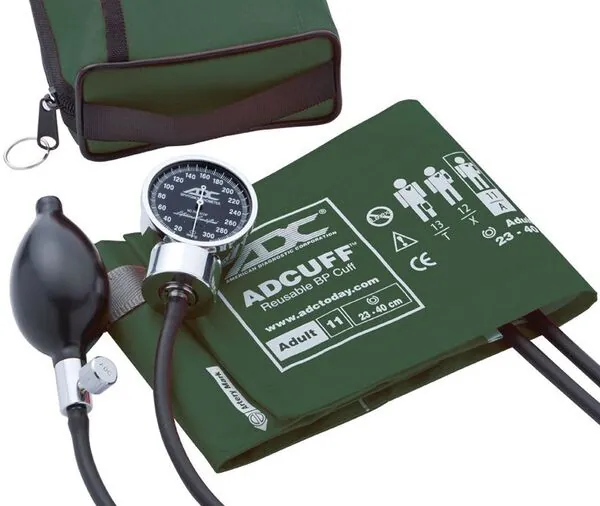
ADC calls the 778 its finest pocket aneroid. For a nursing student, it’s the one cuff that does everything right without getting silly on price.
The dial is the big win. ADC gives it a luminescent face with bold numbers and graduation marks that extend past the needle, so you can read it from an angle and in low light. That helps a lot on a dim night shift or a crowded skills lab.
The air release valve is chrome-plated brass with fine threads. That gives you better control when you’re letting the cuff down slowly, which is exactly the skill you’re being graded on. ADC also adds a filter screen to cut down on dust build-up.
You get a lifetime calibration warranty and a three-year warranty on the cuff and inflation system. It comes with a roomy, color-matched carrying case with two pockets, so there’s space for a stethoscope too.
Who it’s for. Any nursing student who wants one cuff that will last through school and into the first job.
The downside. It costs more than the basic Prosphyg 760 or the Prestige cuffs. And it doesn’t come with a stethoscope.
| Spec | Detail |
|---|---|
| Gauge | 300 mmHg, chrome-plated, luminescent dial |
| Cuff | Two-piece nylon Adcuff, adult |
| Other sizes | Infant to large adult, plus thigh |
| Calibration warranty | Lifetime |
| Cuff warranty | 3 years |
| Latex | Made without natural rubber latex |
2. Prestige Medical Aneroid Sphygmomanometer and Sprague-Rappaport Kit
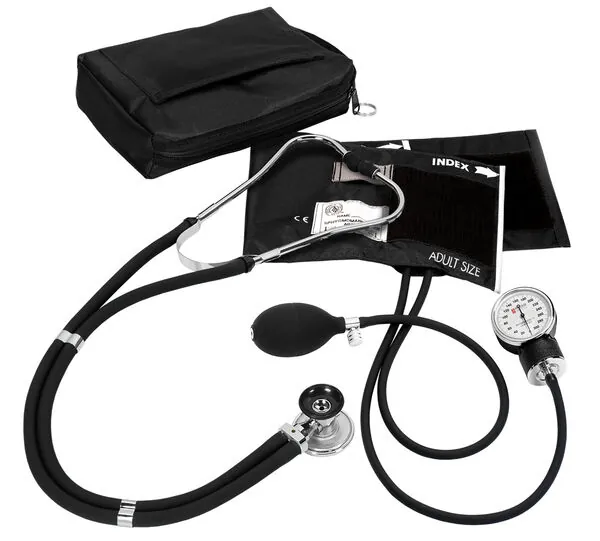
If you need a cuff and a stethoscope and you’re watching every dollar, start here. Prestige’s own site lists this kit at under $75, and it calls it its most popular aneroid paired with its best-selling Sprague-Rappaport stethoscope.
The cuff is nylon and fits a 10 to 16 inch arm. It has index and range markings, an artery marker so you know where to line it up, and an ID label so your cuff doesn’t wander off in skills lab. A matching 6 by 9 inch nylon case holds everything.
The aneroid has a five-year warranty with lifetime gauge calibration. The stethoscope has a lifetime warranty with free replacement parts, and it comes with adult and pediatric diaphragms.
Who it’s for. Pre-nursing and first semester students who need both tools now and want to keep costs down. If you’re in an accelerated program and squeezing your budget, this pairs well with picking one of the cheapest ABSN programs.
The downside. A Sprague-Rappaport is heavy and the double tubing can rub and make noise. It works for learning, but a lot of students upgrade the stethoscope before clinicals.
| Spec | Detail |
|---|---|
| Gauge | Pocket aneroid |
| Cuff range | 10–16 in arm circumference |
| Stethoscope | Sprague-Rappaport, zinc chestpiece |
| Aneroid warranty | 5 years, lifetime gauge calibration |
| Stethoscope warranty | Lifetime |
| Latex | Latex free |
3. ADC Prosphyg 760
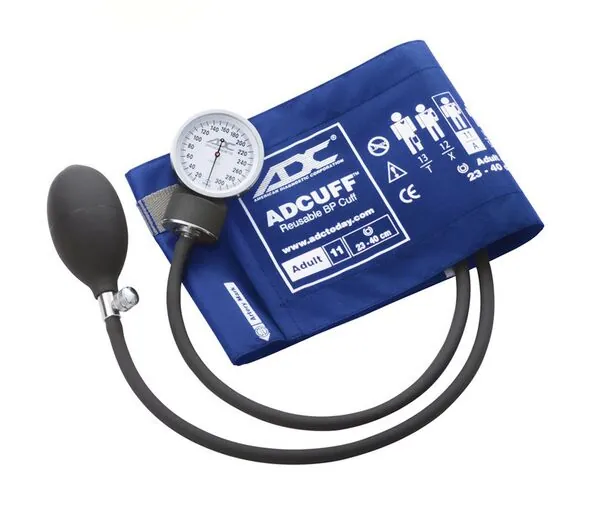
The 760 is ADC’s most popular sphygmomanometer. ADC pitches it at hospitals and schools that want good quality at a fair price.
It’s a simpler take on the 778. You get a black enamel gauge instead of chrome and no glow-in-the-dark dial. The valve is still chrome-plated brass, and the cuff still has ADC’s size guide markings.
The warranty is a bit shorter but still long. ADC covers calibration for 20 years and the inflation system and parts for three. That’s longer than most people keep a cuff.
It comes with a leatherette zip case. The cuff comes in a huge spread of colors and prints, which helps you spot yours in a pile of identical navy cuffs.
Who it’s for. Students who want ADC quality for less and don’t care about a fancy dial.
The downside. The plain dial is harder to read in low light than the 778’s.
| Spec | Detail |
|---|---|
| Gauge | 300 mmHg, black enamel |
| Cuff | Nylon Adcuff, adult |
| Other sizes | Infant to large adult, plus thigh |
| Calibration warranty | 20 years |
| Parts warranty | 3 years |
| Latex | Not made with natural rubber latex |
4. ADC Pro’s Combo III
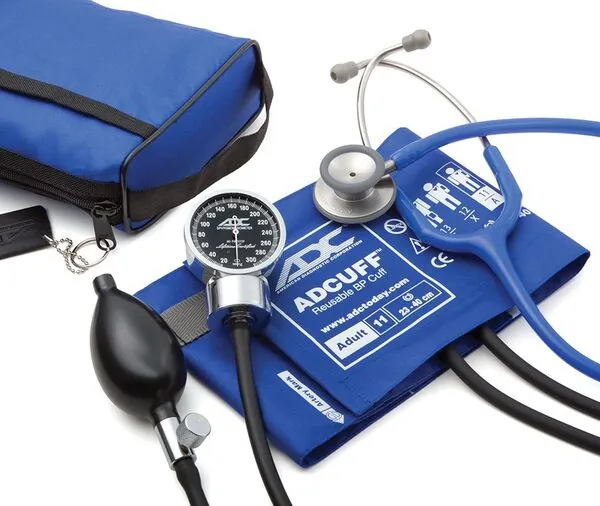
This is the 778 cuff from our top pick plus ADC’s Adscope 603 clinician stethoscope, in matching colors with one big case. It’s the kit to get if you want to buy once and stop thinking about it.
The cuff side is everything we liked above. Luminescent dial, smooth brass valve, lifetime calibration. ADC adds a three-year warranty on the instrument and the cuff.
The stethoscope is a big step up from the Sprague in budget kits. It’s a single-tube clinician scope with a combination tunable diaphragm and bell, plus ADC’s soft silicone eartips. It costs more than a budget kit, but you’re paying for better parts on both.
Who it’s for. Students who want a matched set that will last past graduation and don’t plan on buying a Littmann.
The downside. If you already want a Littmann Classic, you’d be paying for a stethoscope you won’t use. Get the standalone 778 instead.
| Spec | Detail |
|---|---|
| Gauge | 300 mmHg, chrome-plated, luminescent dial |
| Stethoscope | Adscope 603 clinician |
| Cuff | Two-piece 210 denier nylon, adult |
| Calibration warranty | Lifetime |
| Instrument warranty | 3 years |
| Latex | Made without natural rubber latex or phthalates |
5. Welch Allyn DuraShock DS44
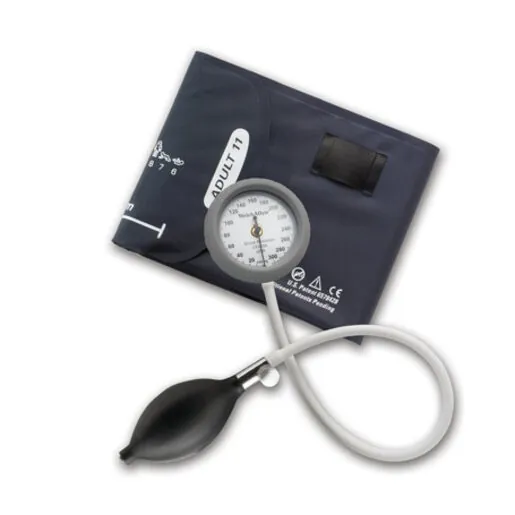
Welch Allyn, now part of Baxter, is one of the big names in hospital vitals gear. The DS44 is its compact, cuff-mounted aneroid.
The point of this one is toughness. Most aneroid gauges use small gears inside, and a hard drop can knock them out of calibration. The DuraShock design is gear-free. Baxter says it meets the AAMI shock-resistant standard. If you’re the kind of person who drops things off tables, this matters.
The gauge snaps right into the cuff and rotates, so you can turn it to face you. No loose gauge to dangle around. This version, the DS44-11C, comes with one adult cuff and a nylon zip case.
Who it’s for. Students who want a gauge that shrugs off drops and want the same brand a lot of hospitals use.
The downside. The calibration warranty is five years, shorter than ADC’s lifetime coverage. Baxter’s list price is also over $100, which is a lot for a cuff with no stethoscope.
| Spec | Detail |
|---|---|
| Gauge | Gear-free DuraShock, cuff-mounted, rotatable |
| Cuff | One adult cuff |
| Case | Nylon zippered case |
| Calibration warranty | 5 years |
| Shock | Meets AAMI shock-resistant standard |
| Latex | Not made with natural rubber latex |
6. ADC Diagnostix 703 Palm Aneroid
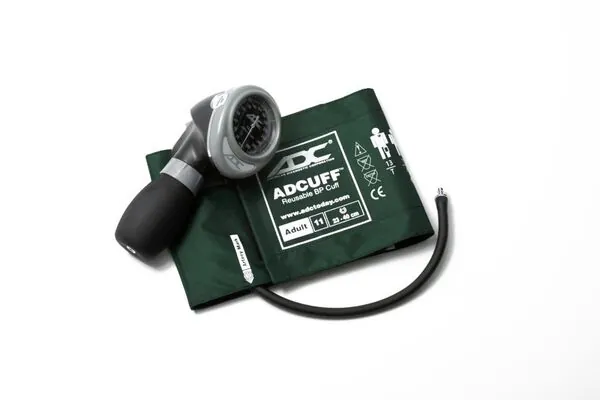
The 703 is a palm gauge. The dial, bulb and release valve are all one piece that sits in your hand. You squeeze to pump and use a trigger to let the air out.
That trigger valve works with either hand, and it lets you control deflation with one hand while the other holds the stethoscope bell in place. Some students find that easier than juggling a bulb and a separate gauge.
ADC houses the gauge in an impact-resistant polymer shell with a metal cage inside for shock resistance. You get a lifetime calibration warranty and three years on the cuff and parts.
Who it’s for. Students with smaller hands who struggle with the bulb, or anyone who just likes one-hand control.
The downside. It’s bulkier than a pocket gauge, and it’s not the setup most instructors teach with. Try one in lab before you buy if you can.
| Spec | Detail |
|---|---|
| Gauge | 300 mmHg palm style, integral bulb |
| Valve | Trigger style, ambidextrous |
| Cuff | Two-piece nylon Adcuff, adult |
| Other sizes | Infant to large adult, plus thigh |
| Calibration warranty | Lifetime |
| Latex | Made without natural rubber latex |
7. Prestige Medical 3-in-1 Aneroid Sphygmomanometer Set
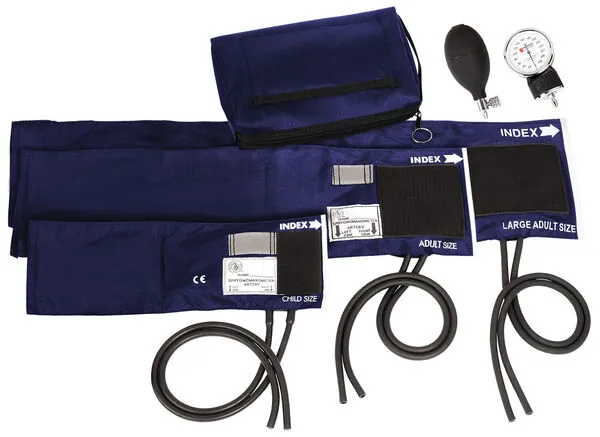
Remember how a wrong-size cuff gives a wrong reading? This set fixes that. You get one gauge and three cuffs that swap in and out.
Prestige lists the ranges as pediatric 7.25 to 10.5 inches, adult 10 to 16 inches and large adult 13.5 to 20 inches. That covers your kid siblings, your classmates and the uncle who lifts. Prestige lists it at under $75, which is a good deal for three cuffs.
Each cuff is nylon with index and range markings and an artery marker. Everything fits in a 6 by 9 inch nylon case. Prestige backs it with a five-year warranty and lifetime gauge calibration.
Who it’s for. Students who practice on a lot of different people, and anyone heading toward peds.
The downside. No stethoscope. And three cuffs take more room in your bag than one.
| Spec | Detail |
|---|---|
| Gauge | Pocket aneroid |
| Cuffs | Pediatric, adult, large adult |
| Cuff ranges | 7.25–10.5 in, 10–16 in, 13.5–20 in |
| Case | 6 x 9 in nylon |
| Warranty | 5 years, lifetime gauge calibration |
| Latex | Latex free |
Which Blood Pressure Cuff Should You Buy?
Keep it simple.
If you want one cuff that will last for years, get the ADC Diagnostix 778. If money is tight and you still need a stethoscope, grab the Prestige A2 kit. If you practice on people of all sizes, the Prestige 3-in-1 covers you.
Whatever you buy, practice a lot. Take blood pressures on everyone who will let you. The first few times you’ll hear nothing but your own heartbeat. Then one day the Korotkoff sounds just click. That’s when check-offs stop being scary.
And while you’re stocking up, have a look at our list of the best books for nursing students. When you’re further along, check how your school stacks up on NCLEX pass rates.